◆ DTO AI Framework · MES · Business platform

A modular platform. Your system, not a template.

DtoMES combines 40 years of ERP/MES experience with a modern architecture of BPL packages, interfaces and thread-safe pools. Multiple databases orchestrated by synchronization, with PostgreSQL as the platform & AI hub, Ollama for local embeddings, and modules that talk to AI through MCP.

30+
Modular BPLs
580+
Pascal units
340k+
Lines of code (ours)
MCP
AI built into the modules
What DtoMES is
Two sections, one platform

An informative side to understand what the product does and who it is for; a technical side for those who want to see how it is built. Same platform, two levels of reading.

💸 Informative section

The platform, the verticals (manufacturing and associations), why DtoMES, our story and contacts. Value before the details.

Platform · Verticals · Why →

🧩 Technical section

BPL architecture, PostgreSQL as the data hub, local AI with Ollama and MCP, modules (Production, Planning, Laboratory, Documents), MemoryLens, security and audit.

Architecture · AI & MCP · Modules →
Principles
Architectural choices, not compromises

🔗 Real modularity

Each module is an independent BPL: it compiles, tests and ships on its own. Updating a module means replacing one .bpl file. Instant rollback.

🔄 Multi-database integration

The platform is multi-database by design: Firebird for the MES, SQL Server/COBOL for the ERP, PostgreSQL as the platform & AI hub. Hash-based synchronization keeps them aligned, with no triggers on source tables.

🤖 AI as part of the system

Not a chatbot in a corner. Embeddings run locally with Ollama; modules expose and consume AI tools via MCP. AI becomes infrastructure.

🔒 Security by design

Centralized RBAC, declarative enforcement on forms and actions, access audit on PostgreSQL, separation of duties. Foundations ready for future reviews.

📜 Traceability

Every piece of data leaves a trail. Audit log and append-only hash chain: if a result is wrong, you can trace the cause event by event.

🌐 Multi-country

Common management, local accounting: adding a country is configuration, not rewriting. A neutral accounting contract with a per-country profile.

The technology shift
PostgreSQL as the hub, Ollama for embeddings, MCP for AI

The platform's data layer converges on PostgreSQL (with pgvector for embeddings), while synchronization keeps the operational databases aligned. Semantic intelligence runs locally with Ollama; integration with AI models goes through MCP, the protocol that exposes modules as tools.

Data

PostgreSQL

The hub for platform services: identity, permissions, telemetry and documentation. With pgvector it also holds embeddings: semantic search next to the data, without a second engine.

Local embeddings

Ollama

Embedding generation runs locally, without sending sensitive data outside. Documents, notes and knowledge base become vectors for semantic search and contextual support.

AI integration

MCP

Model Context Protocol: modules expose tools (documents, modules, scaffolding, archive) that AI models can use safely and traceably. It is the bridge between the platform and AI.

In practice: one AI stack to install and maintain (PostgreSQL + Ollama), AI working on real data through MCP, and no data leaving the company for embeddings. And there's more: dashboard (DAH), telemetry (SEH), audit, documentation, log and synchronization are framework services that every module inherits automatically by following the MCP server's rules. The central nervous system →
Modules
Explore the modules in detail
Verticals
One engine, many sectors

🏭 Manufacturing (MES)

The historic core: production, planning, laboratory, documents, synchronization with the legacy ERP. The domain where the platform is already in production.

Go to verticals →

🤝 Associations

Members, fees, book sales, events, accounting and compliance. Common management, local accounting — the same multi-country model.

Associations vertical →

Anchor case: the Esperanto network, the same entity in every country. The Associations vertical also has an Esperanto version.

Our journey
40 Years of Evolution

From a revolutionary idea in 1985 to today's AI-powered future.

1985

The Original Vision

A “virtual machine” written in C for SCO Unix that read text configuration files and generated a complete ERP system. Configuration instead of code — and ten years of continuous operation.

1995

The Windows Transition

Windows and Delphi changed the industry's paradigm. We adapted, but the data-driven DNA stayed in every system we built.

2000-2024

Field Experience

ERP, MES, PLM and Field Service systems for manufacturing and services. Systems still running today and still generating value.

2025

Back to the Future

DtoMES / DTO AI Framework: the 1985 vision realized with 2025 technology. BPL architecture, PostgreSQL as the hub, local embeddings with Ollama and AI integrated via MCP.

White-paper
Costruire ERP by design

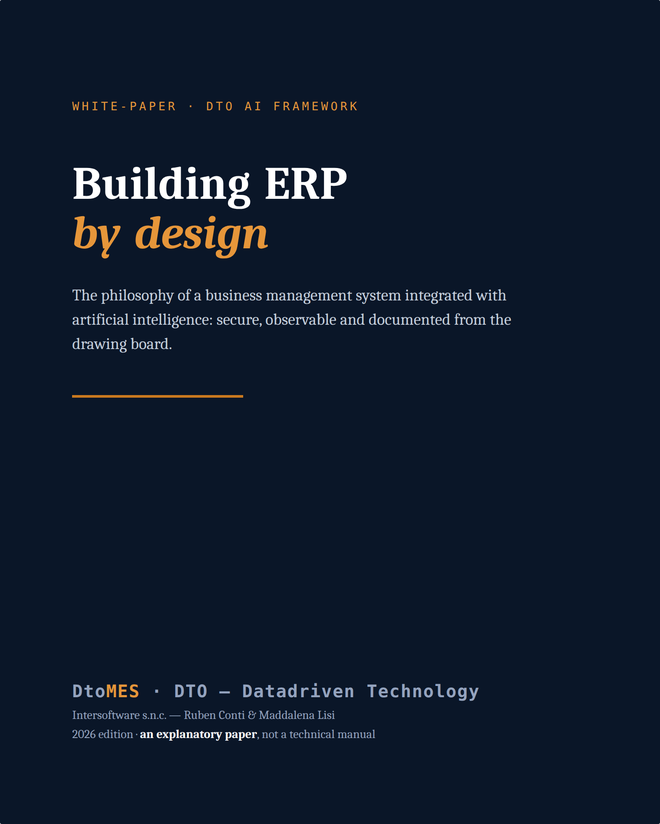
A short book (~23 pages) on the philosophy of an AI-integrated business system: secure, controlled and documented by design. Interfaces, MVP pattern, MCP, integration and multi-country — explained for the value, not the code.

Get the PDF (leave your email) →
White-paper Building ERP by design

A platform built to last

40 years of experience. Modern architecture. Data on PostgreSQL. AI built in via MCP.

Let's talk → Our story
FAQ
Frequently asked questions
What is DtoMES?
DtoMES is a Manufacturing Execution System (MES) and a modular business platform, built in Delphi with a BPL package architecture. Data lives on PostgreSQL and AI is integrated into the modules through the MCP protocol.
Is DtoMES an ERP or an MES?
It is a modular platform covering the MES area (production, planning, laboratory, documents) and integrating with the company ERP. The approach is multi-database: each system keeps its own database and synchronization keeps them aligned.
What technologies is it based on?
Delphi (BPL packages, interfaces, thread-safe pools), PostgreSQL as the platform and AI hub with pgvector, Ollama for local embeddings, and MCP as the bridge between the modules and AI. Hash-based synchronization keeps heterogeneous databases such as Firebird and SQL Server aligned.
Do data and AI stay in-house?
Yes. Embeddings are generated locally with Ollama and data never leaves the company infrastructure. MCP acts as a controlled, documented bridge to AI, without sending data to external services.
Does DtoMES integrate with existing business software?
Yes. Through synchronization and a universal connector, DtoMES works alongside existing systems instead of replacing them, keeping each database as the source of its own data.
Who develops DtoMES?
DtoMES is developed by Intersoftware s.n.c. (DTO — Datadriven Technology brand), with over 40 years of experience in ERP and MES software. Contact: info@snelloerp.eu.